
Staying Calm Under Pressure: Mental Wellness Strategies During College Applications
- info8148474
- Sep 23
- 5 min read
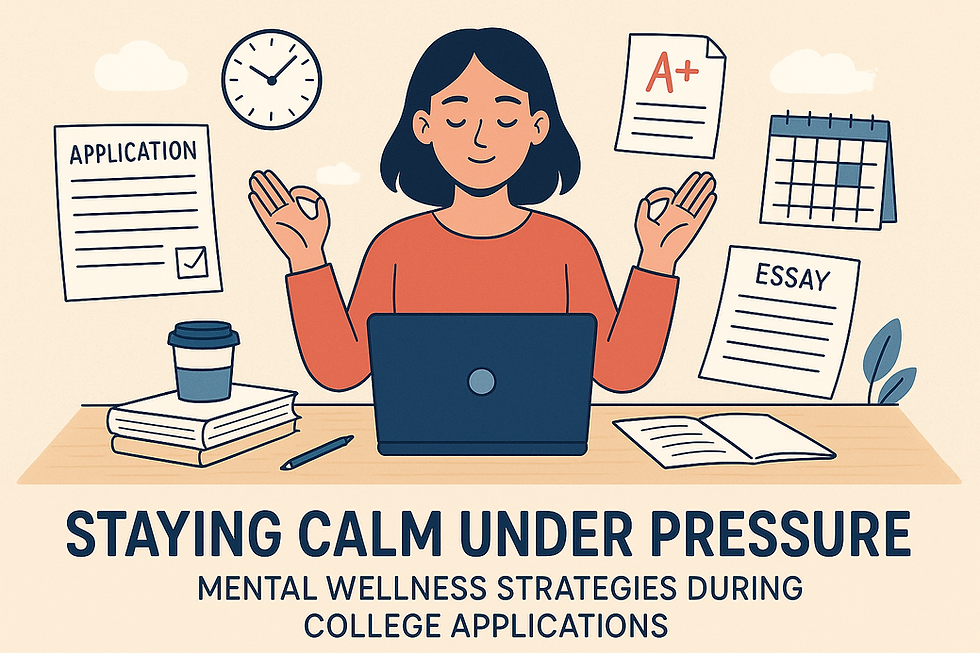
For high school students, a college application season is the most exciting yet overwhelming chapter of academic life. Test-taking, essay-writing, collecting recommendation letters, and filling out university forms along with submitting school assignments and taking unlimited number of tests cram this short stormy period with unlimited pressure. For the in-between breaks, students have to manage classes, extracurricular activities, and sometimes some household responsibilities.
In fact, the college application process is more than an academic challenge: it is instead a real emotional marathon. Managing stress, anxiety, and self-doubt during this time is as important as working on your essays and going to interviews. In this blog, we will go through some practical mental health tips to help students maintain balance, stand resilient, and keep their perspective amid the pressure of college applications.
Why Mental Health Matters During Applications
The state of mind plays a vital role in shaping students' outlook when dealing with admission procedures. Stress, if not handled, can act as a major infiltrator in focusing power, getting good sleep, and making decisions. The student experiencing burnout may find it difficult to write powerful essays or perform well under an interview.
According to the American Psychological Association's 2023 Survey, extreme stress from the college admission season was reported by more than sixty percent of U.S. teens, with many further stating it had harmed their physical health. Anxiety about the competition, accepting possible rejection, and being unsure of future prospects paint an extra emotional burden.
When Should Students Start Prioritizing Mental Health
While most students tend to consider matters of mental health only when deadlines are knocking at the door, in reality, self-care should begin much earlier. In essence, stress builds slowly; therefore, by cultivating healthy habits at an early age, those habits may protect an individual from experiencing burnout during an essential or more stressful period.
Spring of Junior Year: Test prep begins for many students during this time. With the added pressure of SAT or ACT prep on top of school classes, stress may mount, making it crucial to begin practicing stress relief techniques.
Summer Before Senior Year: Time gets allotted for brainstorming essay ideas, working on personal statements, and finalizing college lists. If they wait too long or try to rush through these tasks, stress will skyrocket. Encouraging balance here helps work in favour of senior year.
Fall of Senior Year: Most stressful time, with early action, early decision deadlines, and then regular decision applications. Students will need to manage essays, recommendations requests, and school work. The power of good mental health habits can truly get through this busy season.
By weaving self-care into these stages, students create a foundation that will support them throughout the application cycle.
How to Maintain Mental Health During Applications
Basics to Anchor Yourself
In the basic sense, physical well-being affects mental health. Students are encouraged to accomplish these objectives:
Follow a very regular sleep schedule and try to get at least eight hours of sleep.
Do not stay up late if one tends to be anxious, and keep caffeine intake low, since these two factors can greatly amplify anxiety.
The use of planners or digital apps for tracking of deadlines will help in reducing the stress levels related to forgetting important dates.
In the stormy part of the show, these straightforward routines give one some stability.
Academic and Emotional Balance
Breaking down huge tasks into several bite-sized goals prevents the feeling of being overwhelmed. For instance, instead of deciding to finish a whole essay or paper within a week, a student might set smaller goals such as brainstorming ideas on Monday, having an outline ready by Wednesday, and writing the first paragraph on Friday.
Small celebrations keep motivation feeding. Every task completed, big or small- asking for a letter of recommendation, finalizing a school list, etc., should be acknowledged.
Journaling, meditating, and mindfulness are good practices to keep things balanced emotionally. Even a little bit (10 minutes or less) of grounding every day through reflection or deep breaths calms the nervous system and slows down racing thoughts.
Consider Maya, an upcoming senior applying to fifteen schools. Instead of waiting to the last minute, she scheduled her essay writing throughout three months; the weekends were reserved for drafts and the weekdays for revisions. By following this schedule, she balanced in things like self-care on a weekly basis: dance and walks, which kept her stress level manageable.
Tailoring Mental Health Strategies for Different Students
Not all students encounter identical pressures; hence, mental health strategies should be customized to address individual circumstances.
Those who exhibit signs of perfectionism tend to benefit from realizing than being just honest and genuine will help them achieve the quality they are aiming for, setting a limit on the number of applications to send also helps in reducing unnecessary stress.
The application process becomes very confusing for individuals who have decided to apply to international universities in their senior year, since they have a lot to catch up on. Seeking assistance as soon as possible stops the confusion from turning into demoralizing stress.
Assignments and family responsibilities is somehow draining when mixed with applications. Such students should prioritize time management techniques, and if warranted, ask for flexibility and support teachers.
Common Mistakes to Avoid
Even well-intentioned students sometimes end up in traps that affect their mental health during applications:
Postponing self-care: When stress is only attended to at its peak, students will end up burning out.
Spending too much time on academics and applications: Taking too many advanced courses and then applying to dozens of schools without any scheduled structure seems just like an energy drainer.
Comparing with peers: Keeping track of where their friends are applying or who has already gotten acceptances creates unnecessary anxiety.
Taking rejection as failure: Admission rates at top universities are under four percent. A rejection is not a judgment of worth: rather, it is a statement of the competitiveness of the system.
Avoiding these pitfalls anchor them and help keep their focus during the selection process.
Final Checklist
During the applications period, students can run through this quick checklist to keep themselves mentally and emotionally on track.
Maintain a balanced routine that includes sleep, nutrition, and exercise.
Use calendars and/or apps to keep track of deadlines and tasks.
Try at least one stress reliever a day: journaling, or an enjoyable hobby.
Lean on whichever trusted adult you might need: counsellor, teacher, or family member.
Put social media on low-usage through decision season to prevent an excess of comparison stress.
Applications are one step; they are not your entire story.



Comments